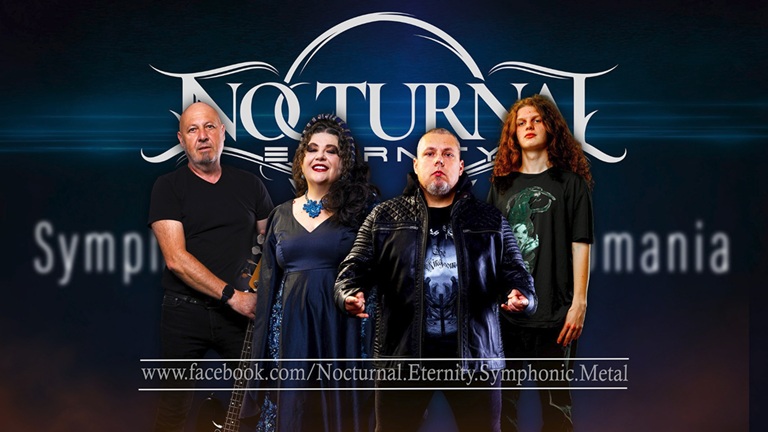
Nocturnal Eternity are one of the most promising new acts on the contemporary symphonic metal scene. Hailing from Transylvania, Romania, the band released their debut album, “Eternity”, two years ago. We had a very interesting conversation with Mihály Manache, the band’s founder, composer and guitarist, who proved to be a wonderful person to talk to. As you will discover through his answers, what matters most to Nocturnal Eternity is the emotions they express through their music and lyrics. And I couldn’t agree more! Read our conversation and see for yourselves!
by Dimitris Zacharopoulos
Nocturnal Eternity are a new name on the international symphonic metal scene. How did the band come together? What was the original idea behind forming the group?
Nocturnal Eternity began in 2020, initially under the name Nocturnal. The project was born from my desire to create something more than just another metal band. I wanted to combine the power of heavy metal with the emotional depth of classical and orchestral music, creating compositions that could tell stories and take listeners on a journey. I’ve always believed that music should communicate something meaningful. Technical ability is important, but without emotion and purpose, even the most complicated composition can feel empty. In 2024, we adopted the name Nocturnal Eternity, which better reflected our musical identity and artistic direction. From the beginning, I have been responsible for composing the music and developing the artistic vision. Building a band around that vision hasn’t always been easy, especially when finding musicians who share the same commitment and ambitions. But I never wanted Nocturnal Eternity to be simply a local project. My goal was always to create music capable of reaching audiences beyond borders.
Your debut album, “Eternity”, was released approximately two years ago. How do you see this album now? Would you change something to it, if you had the opportunity?
Looking back at “Eternity”, I still feel incredibly proud of what we accomplished. It was our first major statement as a band, and it represents years of ideas, emotions, sacrifices and hard work. Of course, as a composer and producer, I hear certain details differently today. Experience changes your perspective, and there are always things you might approach differently with the knowledge you have gained. Perhaps I would experiment more with certain arrangements or production elements. However, I wouldn’t change the soul of the album. “Eternity” captures a particular moment in my artistic development, and I believe that authenticity is more important than technical perfection. An album should represent who you were when you created it, not who you might become several years later.
“Eternity” is described as a 45-minute cinematic concept album consisting of eight interconnected songs. When did the idea of telling a single story through music first come to you?
The idea developed naturally during the early stages of composition. I have always been fascinated by film soundtracks and the way music can communicate an entire story without requiring a single spoken word. When I started writing the material for “Eternity”, I realized that the compositions shared a common emotional direction. Instead of treating them as completely independent songs, I decided to connect them through a larger narrative. The story follows a symbolic character through different stages of existence, from innocence and discovery to love, disappointment, suffering and ultimately personal transformation. I wanted the listener to experience the album almost like watching a film, where every song represents another chapter. For me, the concept wasn’t something added after the music was written. It became part of the creative process itself.
The Dragon stands at the heart of the album’s story, representing strength, vulnerability, sacrifice and rebirth. Why did you choose this particular symbol, and what does it mean to you personally?
The Dragon is one of the most fascinating symbols in mythology, because it represents so many different things. It can be powerful and frightening, but also wise, protective and deeply connected to the mysteries of existence. For me, the Dragon represents the human spirit. We all carry strength within ourselves, but we also experience fear, disappointment, vulnerability and moments when we feel completely defeated. The Dragon in our story is not an invincible creature. It suffers, makes mistakes, loses things it loves and sometimes struggles to find a reason to continue. But it also discovers that true strength is not about never falling. True strength is about finding the courage to rise again. That is something I believe very strongly in, both as a musician and as a person.
“Eternity” takes the listener through different stages of life, from innocence and first love to heartbreak, loss, darkness, and ultimately rebirth. How much of this journey reflects your own personal experiences?
Quite a lot, actually. Although “Eternity” tells a fictional story through symbolic characters, many of the emotions behind the compositions come from real experiences. Like everyone else, I have experienced love, disappointment, loss, betrayal and moments when life seemed to move in a direction I couldn’t control. I think every composer leaves a part of themselves in their music, whether consciously or unconsciously. Some songs reflect personal memories, while others explore emotions I have observed in people around me. But I never wanted the album to become simply my autobiography. I wanted listeners to recognize their own experiences within the story. If someone hears one of our songs and feels that it describes something they have lived through, then the music has achieved something meaningful.
Concept albums are always challenging because the music and lyrics need to work both individually and as parts of a bigger picture. How did you approach the songwriting process to make sure the eight tracks flow naturally while maintaining their own identities?
The biggest challenge was creating continuity without making every composition sound the same. Each song needed its own musical personality because every chapter represents a different emotional experience. For example, “Are You the One” explores a more intimate and vulnerable atmosphere, while “Face the Trouble” expresses confrontation and determination. “Walk With Me” introduces Celtic influences, giving the story a different emotional colour. At the same time, I wanted the entire album to feel connected through recurring atmospheres, orchestral textures and melodic ideas. I approached the compositions almost like scenes in a film. The transitions between emotional states were just as important as the individual songs. However, I also wanted people to enjoy each track independently without necessarily knowing the entire concept. That balance was essential.
Symphonic metal has a long history, with bands such as Nightwish, Epica and After Forever setting very high standards. How important have these bands been to your musical development, and which other artists have influenced your sound?
Bands such as Nightwish, Epica and After Forever have played an important role in the development of symphonic metal, and I have enormous respect for what they achieved. They demonstrated that metal could successfully incorporate classical music, operatic vocals and cinematic arrangements without losing its intensity. But my musical influences extend far beyond symphonic metal. I appreciate traditional heavy metal, progressive music, classical compositions and film soundtracks. I’m particularly interested in music that creates atmosphere and emotional tension. As a guitarist, I also draw inspiration from the power and precision of traditional metal guitar playing. However, I believe influences should serve as inspiration rather than a blueprint. The challenge is to absorb what you admire and transform it into something that expresses your own personality.
Listening to “Eternity”, one can hear a combination of powerful guitar riffs, beautiful melodies, orchestral arrangements and atmospheric passages. How do you balance the metal and symphonic elements without allowing one to overshadow the other?
For me, the most important thing is that every element serves the composition. I never add orchestral arrangements simply because we are a symphonic metal band. If a passage needs a powerful guitar riff, the guitars should dominate. If the emotional moment requires a delicate orchestral atmosphere, the metal instruments should leave enough space for that atmosphere to develop. I think of the orchestra and the metal band as two parts of the same musical language. They should communicate with each other rather than compete for attention. Sometimes the most powerful moment in a song comes from a massive orchestral arrangement combined with heavy guitars. Other times, a simple piano melody can communicate far more emotion than an entire wall of sound. Knowing when to use each element is one of the most important aspects of composing this kind of music.
The album features some impressive guitar work, with catchy riffs and enjoyable solos. What role do guitars play in shaping the band’s identity, especially within such an orchestral musical environment?
As a guitarist and the main composer, guitars naturally play a central role in our music. I love powerful riffs, expressive melodies and solos that contribute to the emotional direction of a composition. However, I don’t believe a guitar solo should exist simply to demonstrate technical ability. A solo should tell its own little story within the larger composition. Sometimes that means playing something technically demanding, but sometimes a few carefully chosen notes can communicate much more. In Nocturnal Eternity, the guitars provide much of the aggression and energy, while the orchestral arrangements expand the emotional and cinematic dimensions. I want listeners to recognize that combination as part of our identity. We are a symphonic metal band, but the metal element must always remain powerful and convincing.
Vocals are obviously a central element of symphonic female-fronted metal. What qualities were you looking for in the vocal performances, and how important is the emotional interpretation of the lyrics compared to technical ability?
Technical ability is extremely important, especially in symphonic metal, where vocal arrangements can be demanding. But for me, emotional interpretation is even more important. A singer can have an extraordinary voice, perfect technique and an impressive range, but if the performance doesn’t communicate emotion, something essential is missing. Our music tells stories about love, suffering, determination and personal transformation. The vocalist needs to understand those emotions and communicate them convincingly. I particularly enjoy the contrast between beautiful soprano vocals and aggressive growls. Those two approaches can represent completely different emotional states within the same composition. For me, the ideal vocal performance combines technique, personality and genuine emotional expression.
The production of “Eternity” sounds polished and cinematic, while still allowing the individual instruments to shine. What were your goals when working at the Denevér Hangstúdió in Hungary?
Our main goal was to achieve a professional, powerful and balanced sound that could support the complexity of the compositions. Symphonic metal presents particular production challenges because you have many elements competing within the same frequency spectrum. Heavy guitars, bass, drums, orchestral instruments, choirs and vocals all need their own space. We worked with Denevér Hangstúdió in Hungary on the mixing and mastering of the album. I wanted the guitars to remain aggressive, the drums to sound powerful and the orchestral elements to maintain their cinematic character. At the same time, clarity was extremely important. I didn’t want the arrangements to become an indistinguishable wall of sound. The final result needed to preserve the emotional dynamics of the music, from intimate passages to the most powerful sections. I believe the studio helped us achieve an important balance between heaviness and atmosphere.
Symphonic female-fronted metal enjoyed tremendous popularity in the past, but the genre seems to have lost some of its momentum in recent years. How do you see its current state, and do you believe there is still room for new bands to make a difference?
I don’t believe symphonic metal has lost its artistic relevance. What has changed is the music industry itself. There are more bands than ever, audiences are divided across countless platforms, and it has become increasingly difficult for emerging artists to gain visibility. The established names still attract large audiences, but younger bands often struggle to receive the same opportunities. However, I strongly believe there is still room for new artists. The genre doesn’t need another band trying to reproduce exactly what Nightwish or Epica did twenty years ago. It needs musicians who respect its traditions while bringing their own ideas and personalities. I think audiences are still interested in powerful melodies, meaningful lyrics and emotional performances. The challenge is not necessarily a lack of interest in the genre. It is finding effective ways to reach the people who would genuinely appreciate the music.
As a Romanian band, how would you describe the metal scene in your country? Is there enough support for bands playing this particular style of music?
Romania has many talented musicians and a passionate metal audience. However, the opportunities available to independent bands can be quite limited, particularly when it comes to symphonic metal. There are dedicated promoters and people who genuinely support the underground scene, but the overall infrastructure is still developing. In our experience, it has often been easier to find performance opportunities outside Romania than within our own country. We have performed in Bulgaria and Italy, including shows supporting Anette Olzon in Rome and Milan, and those experiences demonstrated that our music can connect with international audiences. I don’t want to criticize the entire Romanian scene because there are certainly people doing excellent work. But I believe there is still a significant gap between the talent available and the professional opportunities offered to emerging bands. For that reason, we have increasingly focused on building our international presence.
Your music brings to mind the golden era of symphonic metal, without simply copying the sound of its established names. How difficult is it to draw inspiration from your heroes while developing a musical identity of your own?
I think developing your own musical identity is a continuous process. Every musician begins by being influenced by artists they admire. There is nothing wrong with that. The problem appears when inspiration becomes imitation. When I compose, I don’t sit down and think about creating something that sounds like a particular band. I begin with a melody, an atmosphere, an emotion or a story that I want to communicate. The arrangements develop around that initial idea. Of course, certain influences will always be recognizable because we are working within an established musical genre. But I believe originality comes from the way you combine those influences with your own experiences and creative instincts. Ultimately, I want people to hear our music and recognize Nocturnal Eternity, rather than immediately thinking of another band.
Which song on “Eternity” was the most challenging to write or record, and is there a particular track that holds a special place in your hearts?
Every song presented different challenges, but “My Time Has Come” holds a particularly important place for me. It represents the culmination of the album’s emotional journey. Throughout the story, the main character experiences different forms of happiness, suffering, conflict and personal growth. By the time we reach this composition, everything comes together. Musically, I wanted to create a sense of achievement and emotional release. Another song that is very special to me is “Are You the One”. It reveals a more vulnerable side of our music and demonstrates that emotional intensity doesn’t always require aggressive guitars or massive orchestral arrangements. Both compositions represent different aspects of what Nocturnal Eternity means to me.
What kind of feedback have you received so far from listeners and the international metal press? Has anything about the reactions to the album surprised you?
The international response has been very encouraging. We’ve received positive reviews and coverage from several European metal publications. For example, Eternity received an 8/10 review from Germany’s Keep on Rocking and another 8/10 from the UK’s Powerplay Magazine. We have also received coverage from outlets in Italy, Spain, Germany and other countries. Metal Hammer Italia covered our live performance in Milan, which was particularly meaningful because live performance is such an important part of our identity. What surprised me most was how naturally our music connected with listeners from different countries and musical backgrounds. When you create something in a relatively small music market, it can sometimes feel as though your opportunities are limited by geography. But music doesn’t recognize borders. Seeing people respond positively to our compositions internationally has confirmed that we are moving in the right direction.
Now that “Eternity” has introduced Nocturnal Eternity to the metal world, what are your immediate plans? Are you already working on new material, and would you consider developing another concept album?
We are currently preparing the next chapter of Nocturnal Eternity. Our second album is planned for release in 2027, and I am very excited about the direction of the new material. I want to preserve the cinematic atmosphere and emotional storytelling that define our music while developing a more mature and powerful sound. The experience gained from recording “Eternity” and performing internationally has influenced my approach to composition. I’m interested in creating music that feels even more dynamic, dramatic and emotionally engaging. The idea of another concept album is certainly appealing because storytelling has always been central to my creative process. At the same time, we are working on expanding our international presence and exploring opportunities for festivals and concerts across Europe. Our goal is to continue growing artistically and professionally without compromising our identity.
If you could choose one thing you would like listeners to take away after listening to “Eternity”, what would it be?
Never give up. That is the central message of the album. Life can be beautiful, but it can also be incredibly cruel. We all experience moments when we lose something important, when our dreams seem impossible or when we begin questioning our own strength. But I believe that even during the darkest periods, there is always the possibility of finding a new direction. The Dragon’s journey represents that struggle. It doesn’t become stronger because life is easy. It becomes stronger because it survives the challenges placed before it. If someone finishes listening to “Eternity” and feels even a little more determined to face their own difficulties, then I believe the album has fulfilled its purpose.
What would you like Nocturnal Eternity to represent in the international metal scene five years from now?
In five years, I would like Nocturnal Eternity to be recognized as a serious and respected international symphonic metal band. Not necessarily because of commercial success or popularity, but because of the quality of our music, our professionalism and our dedication. I would love to see us performing regularly at major European festivals, touring alongside established artists and reaching audiences who genuinely connect with our compositions. However, success for me is not simply about the size of the stage. It is also about building something that lasts. I’ve invested an enormous amount of time, energy and personal sacrifice into this project, and I want that effort to create something meaningful. I don’t expect success to happen overnight. I believe in persistence, discipline and continuous improvement. If people eventually associate the name Nocturnal Eternity with powerful music, emotional storytelling and memorable live performances, I will consider that a major achievement.
Send your message to our readers!
First of all, thank you for taking the time to discover Nocturnal Eternity and learn more about our music. We are an independent band from Transylvania, Romania, trying to build something meaningful through passion, dedication and a genuine love for music. Nothing about this journey has been easy, but every concert, every listener and every message of encouragement reminds us why we started. If you haven’t heard ‘Eternity” yet, I invite you to listen to the album from beginning to end, preferably with headphones, and allow yourself to experience the entire story. Don’t just listen to the guitars, the orchestras or the vocals. Listen to the emotions behind them. And remember that no matter how difficult life becomes, your story is not finished. There is always another chapter waiting to be written. Thank you for supporting independent metal music, and hopefully we’ll meet somewhere on the road! Stay strong, stay metal, and never give up!
Official Links
- Facebook: https://www.facebook.com/Nocturnal.Eternity.Symphonic.Metal
- Instagram: https://www.instagram.com/nocturnal_eternity/
- YouTube: https://www.youtube.com/@NOCTURNAL_ETERNITY_RO
- Spotify: https://open.spotify.com/artist/2ZoC6HCTktSP3aYPKevy8n
- Bandcamp: https://nocturnal-eternity.bandcamp.com/album/eternity
