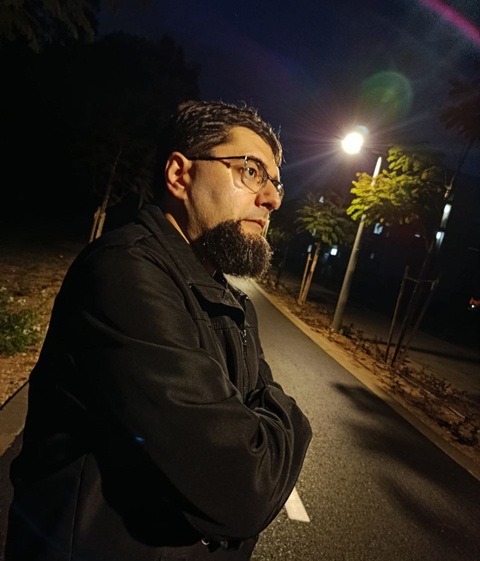
Die Entweihung, the one-man project of multi-instrumentalist Denis Tereschenko, is back with a new album, the jaw-dropping “Worldwide Terror”, a metal record that knows no boundaries, tags or clichés. There are so many great melodies, massive riffs and irresistible grooves here that you will want to hide away with this album. Myth of Rock, already addicted to Die Entweihung and the band’s unparalleled music, talked with Denis Tereschenko, whose words were wise, precise and to the point. And just as interesting as his music.
by Dimitris Zacharopoulos
Die Entweihung started back in 2007. How did you decide to form this music project? How do you look back on the project’s journey so far? What has changed the most in your music since the early (black metal) days?
Die Entweihung started when I was just under 18. I’d been living in Israel for three years, having moved there from Belarus. At the time, I was a big fan of raw black metal and the then-newly emerging DSBM; this music really helped me through my, so to speak, “emigrant depression.” By then, I’d been playing guitar for several years, first on a simple acoustic, then a cheap electric guitar with an amp. I spent a lot of time picking up a bunch of rock and metal songs by ear. Of course, the idea of starting my own band had been in my head since childhood, when I became obsessed with hard rock (a common story for almost every rock fan, right?). But it was my foray into raw black metal that gave me the impetus to pursue my own creativity; I felt like this was the kind of music I wanted to play myself. An additional stimulus came from hearing stories of numerous bands and projects where everything was created by one, or at most two, musicians. I realized I needed to move in this direction. So, in May 2007, the first riffs were written, and by September, the first demo was ready. Now, of course, I can’t listen to it without smiling, but it was the beginning. My beginning.
I think I’ve come a long, interesting way over the past almost 20 years, and my music has evolved from poorly recorded and poorly played black metal to something I personally don’t find a direct analogue to, and for me, that’s, at the very least, a source of pride. Over the years, the lyrics, musical composition, and production quality have changed dramatically, so in a sense I’d say that Die Entweihung, despite existing under that name for 19 years, actually experienced a rebirth around 2015, when I dropped the pseudonym and, a little later, changed the logo. But, of course, some things have remained constant from the very beginning. For example, my love of music.
You are now releasing your new album, “Worldwide Terror”. How are you feeling about that?
It’s a relief, because the work on it dragged on for a while, and then a lot of time was spent preparing the lyric video, the cover, finding labels, etc. I knew from the start that this material would require long and painstaking work in every respect, as the ideas were quite ambitious, but in the end, it took almost four years, which is a very long time between albums for me. On the other hand, quality is more important than quantity, and now I’m trying to spend more time but maximize the result. In the first few years, I had so many ideas that I preferred quality over quantity, and in the end, I paid the price—now I want to redo a lot of the previous albums.
What inspired the album’s title? What does “Worldwide Terror” mean to you personally?
I settled on the title almost immediately, because while I was writing the songs, the war in Ukraine was already in full swing, and after October 7, 2023, a protracted war began in Israel as well. And there’s no less terror in other parts of the world. I would have been happy if this title had no longer been relevant by the time the album was released and had been, so to speak, a kind of “artifact of specific temporal events,” but nothing has changed for the better. People are still fighting, the Israeli government and the United States have dragged Israel into a state of constant war, turning the country and its people into pariahs. And I don’t even want to talk about the war in Ukraine, which has been going on for almost five years now. Russia, a country that for the past decades had been mostly proud of its victory over Nazi Germany, has ultimately erased virtually all of its achievements, becoming the very country it once fought against. So, I see the title as absolutely relevant, and, unfortunately, it will remain so for many years to come.
When and where was the new album recorded? Who did the production? The mixing and the mastering?
The actual recording of the album took place, as always, in my “home studio,” in 2023-2024. The vocals were recorded in Prague, and all additional instruments were recorded at the homes of the people who played them. This is generally standard practice in today’s recording industry. Production was handled by me, as was the mixing. Mastering was supposed to be done by the same person who mastered several previous albums (Yuri DarkDevil—formerly Temptation (Ukrainian), now Pantheon (Israel)), but just as the album was about to be mastered, Yuri suffered serious health problems, and for a long time it was unclear whether he would be able to return to creativity and music in general. To save time, I brought in a third-party sound engineer I found on a freelance platform. He mastered the album, using the mastering of the albums Yuri had worked on as a basis. Now Yuri is in combat readiness, I hope that in the future he will continue to work on my music.
Would you describe “Worldwide Terror” as your most ambitious Die Entweihung release so far? What makes this album different from your previous work?
Yes, of course, every new album is my most ambitious work to date. I always try to move forward creatively, never making two identical albums. The new album could be called the most diverse—it featured instruments that were new to me, and all the songs were stylistically very different. To try to pin the album down to some kind of framework, I used the term “blackend prog thrash,” even though that term itself raises more questions than it answers, and even that definition, in my opinion, doesn’t really define what kind of music it is. You know, there’s a band in Russia called Koma that mixes a lot of things with thrash, and their music was once simply called “eclectic metal.” I think that might be the most fitting term for the music I’m playing now. But, unfortunately, some people still try to pin the music down to a specific framework, labeling my album “thrash metal,” and ultimately criticizing it for the fact that those riffs were played by a different thrash bands many years ago. Well, it’s hard for me to comment such opinions, especially considering that I’ve never liked thrash metal at all, and my music library contains no more than 10 albums of this genre.
Your guitar work is one of the strongest elements of the album. How do you approach writing riffs and building the complex guitar arrangements heard on “Worldwide Terror”?
Thank you! Well, since the guitar is my main instrument, as a rule, all my musical ideas are primarily composed on the guitar, and everything is initially arranged on the guitar and for the guitar. For example, the parts played by other instruments on the album were all conceived on the guitar. Previously, I tried to bring the guitar forward as much as possible, showcasing all my ideas on the instrument on which I was best able to express them, but over the years I’ve begun to give more space to all the other instruments, and now, no matter how complex a riff or harmony is, I try to arrange everything so that it all sounds… comfortable to listen to, so to speak.
There are many different musical influences throughout the album. How do you manage to combine such diverse styles without making the songs sound disconnected?
Well, that’s a question I don’t have an answer to. Most likely, it’s the influence of the wide variety of music I love that informs my songwriting. Some people wonder where, for example, the Eastern melodies in my music come from; I’m not a native Israeli, so I don’t listen to that kind of music. But I really love Orphaned Land, whose music is based on Middle Eastern melodies. And somehow, that stays in my head and then gets combined with heavy or thrash riffs, weird prog time signatures, saxophone solos, and much more.
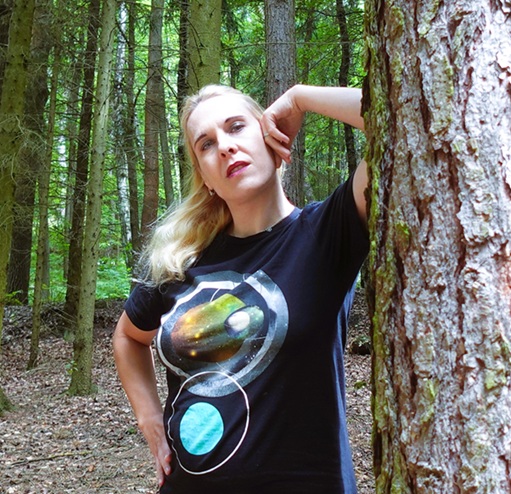
Alena 7 contributes distinctive vocals to the album, moving between melodic and aggressive approaches. How did your collaboration begin? What did she bring to Die Entweihung?
We met about eight years ago, when I was actively contributing to the Russian print fanzine Hellz Zine and the Ukrainian print magazine Atmosfear. At the time, Alena’s main band, Nocturnal Pestilence, was just releasing a new album, and the label they were signed to offered to do an interview with the band. I don’t remember all the details exactly, but I think the initial agreement was to do the interview for Atmosfear magazine. We started communicating gradually, and after doing one interview, I eventually offered her another one—for Hellz Zine. As a result, one thing led to another, and after some time, Alena recorded two songs for my album “Kings & Pawns” (originally released in 2021, reissued in 2024). At the time, it was an experiment, since I’d always performed everything myself (including vocals), and for me, a guest musician—a vocalist, and a woman—was a novelty, although I’d actually been thinking about it for a long time. Ultimately, the next album, “Strict Regime Country,” featured slightly more of Alena’s vocals, but the main vocals were still black metal screaming (sung, incidentally, not by me, but by a guy from Turkey, Bilge “Serpent,” who has many projects and bands, usually more extreme). By the time I was writing “Worldwide Terror,” I had apparently “matured” to the point of making new material entirely with Alena’s vocals. In 2023, we finally met in Prague, and over a glass of local beer, it was decided that she would perform all the songs on the next album. I knew that her vocals would take my music to a much more serious level, plus Alena has a variety of techniques, which will add even more variety to the new songs. The result is, so to speak, my dream come true, since I’ve actually long wanted to make an album with female vocals, in the style of Doro (I’m a longtime fan of Doro / Warlock). But, of course, what turned out in the end is much more interesting than just “weird metal with a vocalist singing in the Doro style”. Alena delivered heartbreaking harshness, and growls, and lyrical clean vocals, and something hard/heavy oriented… in general, I’m endlessly grateful to Alena for her participation; without her, the new the album would have lost a lot.
Did you write the songs with Alena’s voice in mind, or did her vocal performances develop naturally during the recording process?
Initially, I only wrote the music, not really thinking about how exactly Alena’s voice would sound here and there. I knew that, as a professional vocalist, she can sing in any style, so when writing songs, I was primarily thinking about how the songs would come together harmoniously as a whole, no matter whether it was a lyrical piece or extreme black metal. But once the musical skeletons of the songs were ready, I tried very hard to write vocal melodies that would truly blend well with the music. This was new for me, as the vocals in my music usually didn’t have any clear melodies, since for many years the vocals were only black metal screams, and the songs Alena sang on previous albums were songs she arranged mostly herself. For the new album, I initially prepared vocal melodies for her, which Alena relied on while working on the songs, adding her own vision where she saw fit.
“Worldwide Terror” features violin, cello and saxophone alongside the metal instrumentation. What made you decide to introduce these instruments? How do they contribute to the atmosphere of the album?
I’m interested in incorporating new instruments into my music. On previous albums, you can hear bouzouki in some songs (and on the new album, by the way), acoustic guitar, even ukulele. Each new instrument brings something special to the song. Speaking specifically about the instruments you mentioned, when I was writing the new songs, for some reason, the music I was listening to at the time often featured saxophone, and I really liked its sound. By the way, the title track of the previous album, “Strict Regime Country,” also featured a saxophone, but it was a synth saxophone. So, I was certain that I absolutely had to include a saxophone on the new album. The violin – perhaps an influence from King Crimson in 1973-74. The cello – I really love this instrument on the Lake Of Tears album “Forever Autumn.” The cello is only featured on one song, but it’s probably the most important—the closing one—and it turned out very epic, in my opinion. Honestly, I’d like to use a sitar on the next album, but I don’t know yet how it will all work out.
The album contains several progressive elements. How important is experimentation to you when composing music? Do you deliberately avoid musical boundaries?
Well, the more diverse music I absorb, the more new and unusual I want to incorporate into my own music. Speaking of the “progressive” component, in recent years I’ve been listening a lot to bands like King Crimson, Porcupine Tree, various old rock…that’s where all these “weirdnesses” come from.
In fact, the entire history of Die Entweihung is one big experiment. At first, I didn’t have many options, so I used what I had—samples, virtual synthesizers, etc. Over time, it became easier to incorporate more and more new things into the music. Session musicians, new instruments, diverse vocals—I find it all interesting. I know I won’t become a professional musician (in the conventional sense) or make money from this music, so I absolutely don’t care what anyone says – if you like what I do, I’m happy; if not, there’s millions of other, more accessible pieces of music on the internet. In our lives, we’re constantly forced to compromise, to do things we don’t want to do… So, in my music, I decided from the start to make no compromises. The only requirement is that I like the outcome. A sort of “snapshot of my creative self at a specific moment in time.”
Die Entweihung is a one-man project. What are the biggest advantages and challenges of writing, recording and producing music mostly on your own?
Well, let’s start with the advantages. It’s probably pretty self-explanatory: you’re your own boss, you decide absolutely EVERYTHING, from songwriting to how those songs will ultimately sound. You write, arrange, and play yourself. You don’t have to get together with the guys for a rehearsal, which costs a pretty penny. You don’t have to argue with the drummer who drank all night and can’t play. You don’t have to compromise with the second guitarist who wants as many solos as possible, but you don’t want any at all. I think the main idea is clear, haha. No, actually, if you’re capable of doing everything yourself, the one-man project format really does have a lot of advantages. Even live performance isn’t a barrier in this case—there are plenty of projects where one person records everything in the studio (or maybe sometimes adds a session musician on drums), and then assembles hired musicians for live performances.
As for the challenges…well, I’d say that even though I can do most of the work alone, I always try to consult with one or two close friends who can give me feedback and advice. When you’re just starting out on an album, your head is clear, your ears are hearing everything well, and it seems like everything is going great. But the further you go, the more often you run into dead ends. You listen to the mixed version, it seems like everything is fine, you give it to a metalhead friends, and they suddenly say, for example, that the guitar is hard to hear, or the drums aren’t sounding good enough. What I mean is that sometimes it can be difficult to navigate certain moments at different stages of the creative process on your own. While working in a band, other musicians can immediately tell you that “something’s not right,” when working solo, you can miss some important details. Otherwise… well, the days are gone when I really did EVERYTHING. Now I fully understand that, for example, I don’t know how to do proper mastering, so now everything that gets mixed is always handed over for mastering to those who really know how. But otherwise, I don’t know, I think over all these years I’ve gained enough experience to be able to record and mix my own material more or less well. Now I do all this for my own pleasure, without rushing, getting real satisfaction from the fact that “now you have nothing, and a week later, track after track, a new song is born.”
How do you know when a song is finally complete? Do you tend to keep changing arrangements and riffs until the last moment?
No, no, I’m not one of those “perfectionists” who’s willing to spend years redoing the same song because it’s “not good enough”. I don’t know, I usually have a basic idea that I initially write down in Guitar Pro, and then I build on that, adding riffs, solos, etc. Usually, after a few of these “songwriting sessions”, I have a more or less finished piece of music, the parts of which I always try to keep in Guitar Pro. It really helps. If something’s wrong, I can change or redo it, but usually it’s just small things. But endlessly redoing songs isn’t my path. Life is too short to search for that perfect song. It reminds me of audiophiles who constantly change their music equipment in search of the perfect sound, but never find it.
“Worldwide Terror” contains some very dense and detailed arrangements. How do you balance technical musicianship with melody and emotion?
For me, melody is the most important thing in a song. I’m always looking for something in music that will hook me—a vocal melody, a guitar hook, a cool main riff—and I try to do the same in my own music, because if a song doesn’t have something that makes you want to come back to it…that song has little chance, I think. At the same time, I don’t like it when all those hooks and catchy melodies are too superficial; it’s much more interesting when it’s all arranged in a more technical manner, where there’s room for unconventional solutions. Yes, it’s all about balance—it’s crucial to be able to combine melodies, emotions, catchy bits, and technical musicality. Without technique, it’s likely to be some kind of pop rock, and without melodies and emotions, it’s just boring, technical music. I try to combine all of this in a song, sometimes it turns out better, sometimes worse, but I think my songs are mostly not boring, haha.
What themes and subjects influenced the lyrics on “Worldwide Terror”? Are there particular events or ideas behind some of the album’s songs?
Starting with my 2015 album, “Neverending Terrorism,” I’ve radically changed not only my musical direction but also my lyrical themes—now all my lyrics are based on events happening in the world here and now. Not literally, of course, but much of what’s happening in the world is reflected in my lyrics. The new album is no exception. The title track, “Worldwide Terror,” is about the world currently in the grip of terror and war, but we must live, no matter what. “Warriors of the Lie” is about the war in Ukraine, but the lyrics are narrated from the perspective of a Russian “liberator.” “Newborn” is about a child born during a time of war who would like to live a normal life, but he doesn’t even know what that is; instead, he’s forced to stand with a gun and watch, waiting for another enemy soldier to approach his family’s home. “(Not sure) It’s Really your life” is partly autobiographical, but generally applies to many creative people who, under the pressure of life’s circumstances, abandon their creativity for, for example, a prestigious job and children who take up all their time. “Eight Billion Headed Whore” is inspired by the concept of “spiders in a jar,” and this “whore” is our entire planet, all of humanity. We rape and kill each other, step over heads to achieve more, we do what we ourselves enjoy, even if it may harm others. In short, a kind of monster, devouring itself for momentary pleasure, and eventually this monster will disappear. The instrumental “The Brightest Night” precedes the album’s main composition, “The Blackest Morning” – the song tells about the events of the massacre at a festival on October 7, 2023, in Israel.
The album can be described as prog thrash—and much more. If you had to introduce Die Entweihung to someone who had never heard your music, how would you describe its sound?
I think we touched on this topic at the beginning of our conversation, but honestly, I don’t know… Of course, terms like “eclectic metal” or “blackened prog thrash” don’t really help the listener understand what kind of music this is; they’re too vague. I read something like “Guns n Roses meets Venom” in one review; maybe that’s appropriate? Okay, just kidding. I’d describe this album as “melodic, yet underground, raw heavy metal with strong female vocals, standard song structures but with unconventional elements within the songs». Overall, it’s best to listen to the album for yourself and draw your own conclusions. I don’t like labeling and describing music, especially my own; it’s a thankless task.
Extreme metal has changed considerably since you started Die Entweihung in 2007. How do you view the modern metal scene? Do you think it has become easier or harder for independent artists to be heard?
I’m not saying anything new; I think everyone’s already talking about it. It’s a double-edged sword. On the one hand, everyone now has access to decent-quality recordings and all the tools to instantly publish their music online, meaning there are far more opportunities to get your music out there. But here’s where the “spiders in a jar” concept lies—the internet has become a giant pit crawling through everyone, from big artists to underground projects, all of whom are now “content creators.” Once upon a time, as a listener, a single review in a music magazine was enough to make me go out and buy a cassette; now, instead, I need that damn algorithm to push some song that, in its “authoritative opinion,” I should listen to. Add to this the emergence of all these AI “creators” that artists have to contend with, plus the widespread inability of people to tolerate music longer than 3-4 minutes… Extreme metal, and metal in general, was once a counterculture, and it was considered good form to play by your own rules rather than the masses, but now everyone plays by the same rules, so that His Majesty the Algorithm can promote you. All in all, it’s a very strange time for musicians. The digital god has finally won. It’s great that the 20th century didn’t have all that, and we inherited the great legacy of the iconic rock and metal legends of the 1960s-90s. I’m sure if a band like Pink Floyd came along today, they wouldn’t be able to create what they did at the level they achieved back then. All those great covers, the sound production, the long rock tracks, 10-20 minute long…intros like “Shine on You Crazy Diamond” would hardly be appreciated today. However, true music fans always exist; the question is whether it could have become mainstream.
Which musicians, bands or albums have had the greatest influence on Denis Tereschenko as a songwriter and multi-instrumentalist?
Metallica would definitely be first. I’ve loved all of their songs, including the infamous St. Anger, since childhood. I consider them the perfect and best metal band, both studio and live (I’m talking about their heyday, the 80s and 90s; of course, they’ve lost a lot of their technique in the last 20 years). If we take black metal, I’d say Burzum, especially “Filosofem”. If it weren’t for that album, DSBM wouldn’t be what it is. By the way, this is a great example of a one-man project. In fact, I listen to a lot of different music, and the list here would contain hundreds of names. I listen to many bands very selectively. For example, I like 3 Tiamat albums, but I don’t like everything else. It’s hard for me to say that “this particular musician had the strongest influence on me». I equally love albums by Paradise Lost or Bathory. I am influenced by all the music I listen to, and it’s not necessarily metal or rock music.
After releasing “Worldwide Terror”, what are your plans for Die Entweihung? Some live shows maybe? Are you already thinking about the next album or new musical directions?
Over the next couple of years, I’m planning to remix and rework some of my older albums. Some will have a new mix, some will have lyrics translated from Russian to English and, accordingly, will have new vocals, and some will have new bass. For now, I’m planning to rework three albums from the middle period (the 2010s). We’ll see what happens after that. I don’t have any plans for new material yet, but I think I’ll start working on something completely new next year. There won’t be any live shows; this project will remain strictly studio-based.
Finally, what do you hope listeners will feel or discover when they reach the end of “Worldwide Terror”? What would you like to say to those who are about to enter the world of Die Entweihung for the first time?
Give this music some time, I hope you’ll find something you really like and it stays with you for a long time. Thank you so much for the interview! Stay metal!
