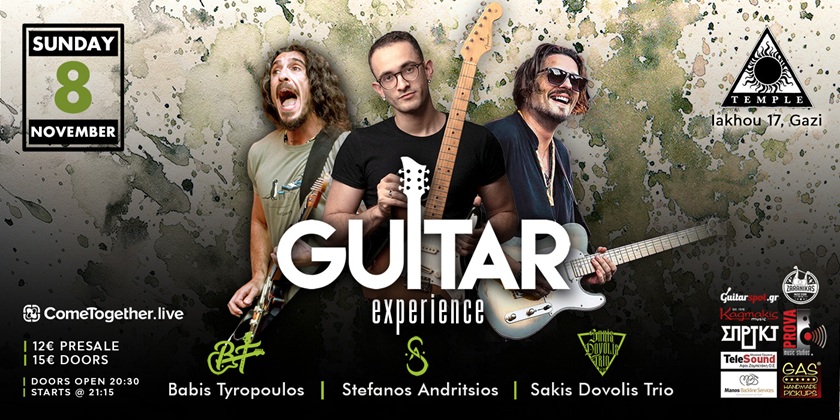
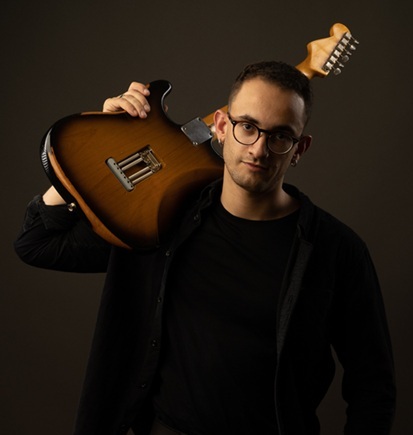
Stefanos Andritsios is one of Greece’s biggest new guitar talents, a guitarist and composer who proves that music is much more than technique. With influences ranging from Andy Timmons and Jeff Beck to Gary Moore, Joe Satriani and Steve Vai, he uses the electric guitar as a voice to express emotions and tell stories without words. Following his debut EP, “Inner Fight”, he recently returned with “Para Siempre”, a four-track instrumental rock release inspired by love, family, loss and memories. On November 8, he will join Sakis Dovolis and Babis Tyropoulos for Guitar Experience vol. 4 at Black Temple in Athens. So, we talked with Stefanos about his music, his latest EP and the power of guitar.
by Dimitris Zacharopoulos
What does the electric guitar mean to you personally? Is it more than an instrument?
The sound of the electric guitar has always drawn me in. There’s something about the way it can express emotion without a single word that I love, and that’s a big part of why instrumental guitar music means so much to me. It’s also a very personal escape. Whatever is on my mind, the moment I pick up the guitar and touch the strings, I feel the stress start to fade. I become absorbed in playing, and everything else feels a little further away. So yes, for me it’s much more than an instrument.
Do you remember the first guitarist who made you want to pick up a guitar and play? In your opinion, are there any new guitarists that stand out? Name three of them please!
Iron Maiden were the first band that really drew me deeper into guitar music. Watching Adrian Smith, especially playing “The Trooper,” made me want to pick up a guitar and learn to play. His playing made a huge impression on me. Three guitarists I really love today are Andy Timmons, Nick Johnston and Lari Basilio. They each have such a distinct musical voice,
Stefanos, Sakis, Babis, you all participate in Guitar Experience vol. 4. What do you think connects the three of you as guitarists?
I think what connects the three of us is our love for music. We each have our own style and approach to the guitar, but that shared love is more than enough to bring us together.
How has your relationship with the guitar changed since you first started playing?
My relationship with the guitar keeps evolving, but my hunger to learn hasn’t changed at all. There’s always something new to discover, practise or explore, no matter how long you’ve been playing. That curiosity is what keeps me coming back to it.
Do you believe a guitarist needs great technical skills to create something that really moves people?
No, I don’t think you need exceptional technical skills to create music that moves people. A simple melody, played with feeling, can say a lot. Of course, the more comfortable you are with the instrument and the stronger your technique becomes, the easier it is to express what you hear in your head. For me, that’s the purpose of technique: to help you communicate your musical ideas.
How important are your personal experiences, emotions and memories when you write or improvise music?
They’re at the heart of the music I write. The guitar gives me a way to express feelings that I sometimes find difficult to put into words. My new EP, “Para Siempre”, is very personal. “Bianca” was written for my sister, while “Farewell” and “Ultima Vuelta” are connected to Layla, our dog who passed away last year. The title track is about the people we want to keep in our lives forever. Those experiences guide the melodies, the phrasing and the mood of each piece. When I improvise, it’s a similar feeling: I try to follow what I’m feeling in that moment and let it come through in the playing.
Blues, rock, funk, jazz, instrumental music, all meet in your musical worlds. How important is it for you to keep experimenting instead of staying inside one genre?
I think it’s important to stay open-minded, because every genre has something to offer. It might be the phrasing in blues, the energy of rock, the groove of funk or the harmonies in jazz. Listening to different styles gives you new ideas and helps you grow as a musician. I like exploring whatever catches my ear and letting those influences find their way naturally into my own music.
What makes a great guitar solo for you? Is it technique, tone, feeling, melody or something completely different?
Melody, definitely. I love a solo that stays with you—something you can sing in your head even when the song isn’t playing. The solo in “Bohemian Rhapsody” is a great example. As soon as I think of it, I can hear and sing the melody. For me, that’s a real achievement, because it feels written to serve the song. Technique, tone and feeling all play a part, but what matters most is how the solo fits the music and what it leaves with the listener.
You have all played with many different musicians and in very different environments.What have other musicians taught you about playing the guitar that you could never have learned alone?
Playing with other musicians has taught me that you often don’t need even half of what you think you should play! Less is more, haha. When you’re playing alone, it’s easy to fill every space. In a band, you learn to listen, leave room for the others and understand what the music actually needs. Sometimes a few well-chosen notes—or simply knowing when to stop playing—make the biggest difference.
How different is playing guitar on stage in front of an audience from playing in the studio? Which one brings out the best in you?
Each has its own appeal. In the studio, you have time to follow your imagination, experiment with different sounds and explore ideas until you find what works for the music. On stage, there’s definitely some nervousness at first, but as you settle in and connect with the audience, the feeling is incredible. Their energy becomes part of the performance and can bring something unexpected out of your playing. I wouldn’t choose one over the other. They bring out different sides of me, and I love both.
Gear is obviously an important part of the guitarist’s world. How much does the right guitar, amplifier or effects setup affect your creativity and your playing?
You definitely want gear that feels comfortable and doesn’t make your life difficult. A guitar that plays well and a sound you enjoy can help you relax and get creative. Beyond that, so much of your sound comes from your fingers—your touch, phrasing and dynamics. Whether a pedal costs €30 or €300, you can usually find a way to make it work for you. I enjoy gear, but the price tag doesn’t determine how much music you can make with it.
Is there a particular song or guitar performance that you have written or recorded that still gives you goosebumps, when you hear it today?
Definitely the solo in “Inner Fight,” from my first EP. Even now, when I listen back to it, it still gives me goosebumps. There’s something about that particular performance that stays with me.
You will share the same stage at Guitar Experience 2026. What are you personally looking forward to hearing from the other two guitarists that night?
I’m looking forward to enjoying both sets and hearing what Sakis and Babis bring to the stage. They’re both great players, and I’m sure there’ll be a few moments that make me think, “OK, I need to go home and practice!” Haha.
If the three of you had to create one song together, what would you like it to sound like? Would it be blues, rock, funk, something completely different—or all of these together?
Probably a bit of everything! With Babis leaning towards blues and jazz, Sakis bringing the blues, and me adding some rock and fusion, I think we’d have plenty of ideas to work with. I’d be happy to start with a good groove and see what happens.
Why should Greek fans not miss the Guitar Experience vol. 4 event? Send a message to them!
It’s a chance to hear three different approaches to the guitar in one night, enjoy some live music and catch up with friends. I’ve attended Guitar Experience as a fan over the years, so being on stage this time means a lot to me. Come join us on November 8 at Temple Athens! We’ve got plenty of music to share, and I’d love to see you there and have a chat after the show.