Amon Amarth have always enjoyed considerable popularity, regardless of the quality of their albums. The Swedes have built their career around ear-friendly, memorable themes that make many metalheads (mainly the peaceful ones) want to grab an axe and cut some throats, while aggressive promotion keeps fans engaged even when the band delivers rather unsuccessful releases.
And there’s proof of this: “Jomsviking” and “Berserker” were excessively melodic by the band’s standards, marking a noticeable shift in the sound towards heavy metal territory. In fact, these were the first albums on which I encountered some weak and uninspired compositions. They may not have struck a chord with the audience, apart from a handful of songs, but they ultimately did little to dent the band’s fanbase. Amon Amarth remain an impressive live act — their concerts are a strong experience, backed by a dedicated production team — and as long as they keep touring relentlessly, generating profits for themselves and local promoters alike, everyone’s happy.
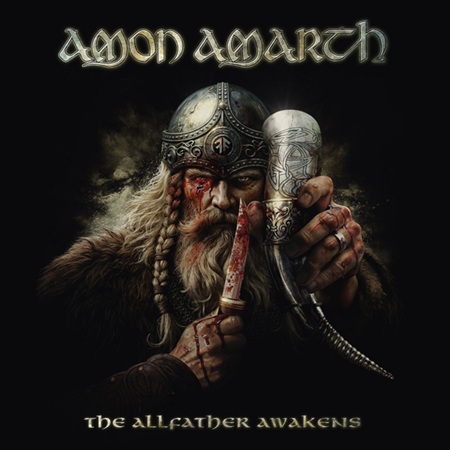
However, there’s another reason for us to be happy this year — and this time for music reasons. You may recall that the Swedes returned to their trademark melodic death recipe with “The Great Heathen Army” four years ago. Now, with their thirteenth album, “The Allfather Awakens”, they further consolidate this direction, delivering an even stronger release that brings to mind their epic works of the past without abandoning the melodicism has characterized their recent era — yet these elements are now more effectively balanced. Indeed, it becomes immediately apparent that the album serves as a (sub)conscious link to the band’s classic material, offering exactly what you’d expect — epic feeling, powerful melodies, growls, and aggression, enhanced by Jacob Hansen’s production, which gives the sound both clarity and heaviness.
The central theme, Odin’s decision to sacrifice his eye in exchange for wisdom, provides the perfect inspiration for the band to develop anthemic, catchy themes and refrains that may not break any new ground in terms of innovation, but they’re certainly uplifting, ensuring the listener’s engagement till the end (“Gjallarhorn”, “We Rule the Waves”, and the galloping “Eight Legs of Thunder” will surely stick in your mind). Söderberg’s and Mikkonen’s guitar work brings back that original belligerent spirit you’ve come to expect from the band, with traditional whirlwind riffs that fulfil their role in “speaking” again with the fans (a connection that had somehow faded on previous releases). And when you have Hegg, that primordial, bearded Viking figure, adding his imposing presence to the band’s material, the result is pretty much guaranteed.
As mentioned earlier, “The Allfather Awakens” resurfaces Amon Amarth’s core (a necessary return). At the same time, it introduces a welcome surprise. The Swedes dare to explore a different, folk-oriented side of their music with their first-ever ballad. Strategically placed midway through the album, “Upphaf” is a majestic acoustic piece that you can imagine yourself listening to it at night, somewhere deep in a forest, around a small campfire (much like in the accompanying videoclip), while Hegg delivers a captivating, haunting performance that perfectly matches the song’s atmosphere. Well, few would have expected the Swedes would go acoustic, but apparently, the time was right.
I also spot other worth listening moments, such as the ominous, dark “Kvasir’s Blood”, where the whispers are an effective atmospheric addition, the more aggressive, death oriented “Die with a War Cry”, showcasing Amon Amarth’s longstanding ability to craft gripping themes, and the title track, with its addictive staccato riffs and mesmerizing patterns (undoubtedly one of the album’s highlights).
“Ascending Like an Eagle” brings the album to a close in a way that perfectly encapsulates Amon Amarth’s determination to return to their established standards, recalling various stages of their career through anthemic, aggressive ideas unfolded through straightforward, easily digestible structures. It leaves you with the feeling that you’ve enjoyed the journey over the album’s three quarters. Personally, I found the Amon Amarth I had somehow lost after “Deceiver of the Gods”.
Overall, I don’t think “The Allfather Awakens” surpasses the band’s classic albums in terms of inspiration and songwriting, but it stands boldly alongside them, serving as a bridge between the present and the past. Its quality and meticulous work are evident throughout, while many of the songs leave you wishing to experience them live someday. The ingredients are familiar and predefined, but this time they have been blended so effectively and enriched with just enough subtle variations to make the result impossible to ignore.
♦ 8/10
Alex Nikolaidis
