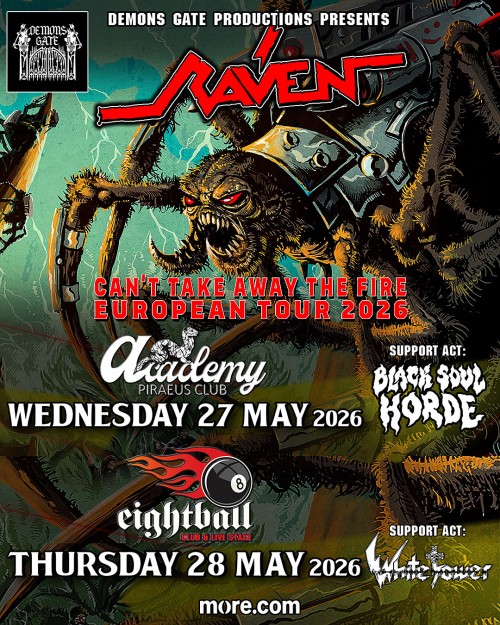

Raven is a legendary heavy metal band that broke new ground in the early ’80s, playing a leading role in the New Wave of British Heavy Metal and earning the respect and admiration of generations through the strength of their remarkable career. As the British metal pioneers prepare to visit Greece for an explosive live show at Piraeus Club Academy on May 27, 2026, Myth of Rock opens the extensive chapter of Raven in the great book of heavy metal history.
by Dimitris Zacharopoulos
Raven never achieved the mainstream superstardom of some of their peers, however, their influence on metal music is immeasurable. Without them, the landscape of thrash, speed and power metal would almost certainly look very different.
Formed in 1974 in Newcastle, England, by brothers John Gallagher and Mark Gallagher, alongside drummer Paul Bowden, Raven emerged from a period when hard rock was evolving into something faster, heavier and more aggressive. Unlike many of their contemporaries, Raven were never content to simply emulate the blues driven hard rock of the early 1970s. Their music embraced experimentation and an almost reckless sense of adventure. Long before “speed metal” had become a recognized term, Raven were laying its foundation. Their sound fused the rhythm of rock n’ roll and the muscle of traditional heavy rock with the precision of progressive music and the raw aggression that would later define thrash metal. Add to that their manic stage presence, and Raven quickly stood apart.

Their live performances became infamous for what the band called “athletic rock”. Wearing sports gear such as helmets, shoulder pads, elbow guards and hockey masks, the band transformed their concerts into high-energy spectacles. It was theatrical, chaotic, and unlike anything metal audiences had seen before. But behind the visual eccentricity you would find serious musicianship.
Signing to the low-budget, but very active at that time Neat Records placed Raven at the center of the New Wave of British Heavy Metal explosion. Their debut album, “Rock Until You Drop’, arrived in 1981 and immediately made an impact. Raw, fast, and unapologetically energetic, it captured a band operating at full throttle. We should mention here that Raven’s first ever release was “Don’t Need Your Money”, a single off “Rock Until You Drop”, which featured great riffs and catchy melodic hooks, a single, which previewed what would follow!

If the release of the single and the debut announced their arrival, 1982’s “Wiped Out” confirmed their importance. Faster and heavier, it became one of the key blueprints for what would become thrash metal. The speed, aggression and technicality heard on the record directly inspired countless young musicians.
Among those paying close attention were future members of the so-called Big Four: Metallica, Slayer, Megadeth and Anthrax. All have acknowledged Raven’s influence. Lars Ulrich has often cited Raven as one of the formative bands that shaped Metallica’s earliest direction (that connection became historic in 1983, when Raven invited a young, unknown Metallica to open on the now-legendary “Kill ’Em All for One” tour. It was Metallica’s first-ever national tour, and Raven effectively helped launch the career of one of metal’s biggest bands).

In 1983 Raven released “All for One”, often considered their masterpiece. Produced by the legendary Michael Wagener, the album captured everything great about the band: speed, complexity, melody and sheer energy. Songs like “Take Control” and “Break the Chain” remain essential listening for anyone studying metal’s evolution.


The mid-1980’s saw Raven sign to a huge label, Atlantic Records, a move that promised major commercial breakthrough. Their 1985 album “Stay Hard” achieved modest success thanks to the single “On and On”, but label pressure pushed the band toward a more polished, commercial sound. The result was “The Pack Is Back’, an album that divided fans and remains one of the most controversial moments in their career. Though technically accomplished, it lacked the wild spirit that defined Raven’s earlier work. To their credit, Raven quickly corrected things! Releases like “Life’s a Bitch” restored their aggression and creative edge, proving the band had not lost its identity.
The departure of drummer Rob “Wacko” Hunter marked the end of a classic era, yet Raven refused to slow down. With Joe Hasselvander behind the kit, the band entered a productive new phase, releasing albums such as “Architect of Fear” and “Glow”. Though grunge and changing trends pushed many classic metal acts into obscurity, Raven kept fighting. Their dedication to touring Europe and Japan maintained their loyal following.
Then came one of the most devastating moments in the band’s history. In 2001, guitarist Mark Gallagher suffered a horrific accident, when a wall collapsed on him, crushing his legs. For many bands, this would have been the end. Not for Raven! After years of rehabilitation, Mark returned — sometimes performing from a wheelchair, a powerful example of perseverance and determination. That spirit fueled 2009’s “Walk Through Fire”, a remarkable return that reminded the world of Raven’s brilliance. They followed it with “ExtermiNation”, “Metal City”, and “All Hell’s Breaking Loose” — each proving the band remained as ferocious as ever.
Today, Raven continue to set their guitars ablaze and scream with untamed intensity, both on their studio albums and during their thunderously loud live performances. They were pioneers and they remain metal survivors. They are the absolute architects of metal chaos, their riffs and screams still sound unique today, soaring higher and higher!
For those of you who want to experience the sheer madness, intensity, and authenticity of Raven, make sure to head to their live show in Athens in just a few days. This will be a rare chance to witness, hear, and fully enjoy a truly iconic band — one that has left a profound and lasting mark on heavy music. Raven is set to tear down Piraeus Club Academy with a jaw-dropping performance! Rock ‘till you Drop! Aaaaaargh!