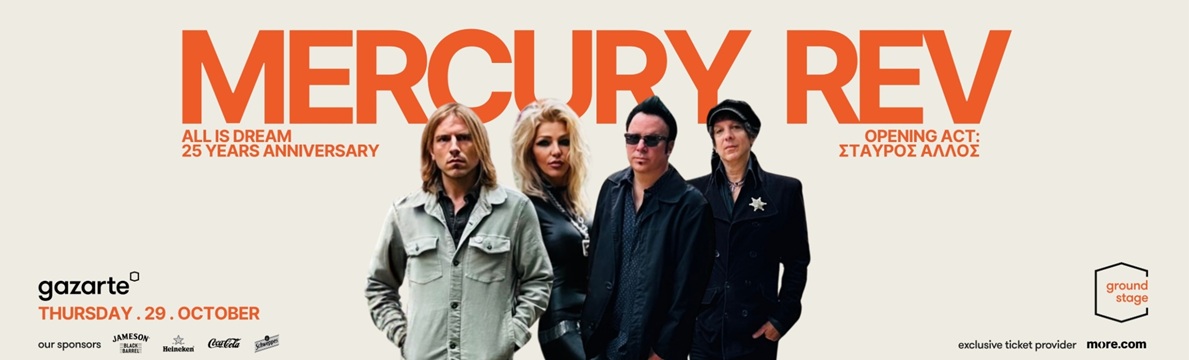
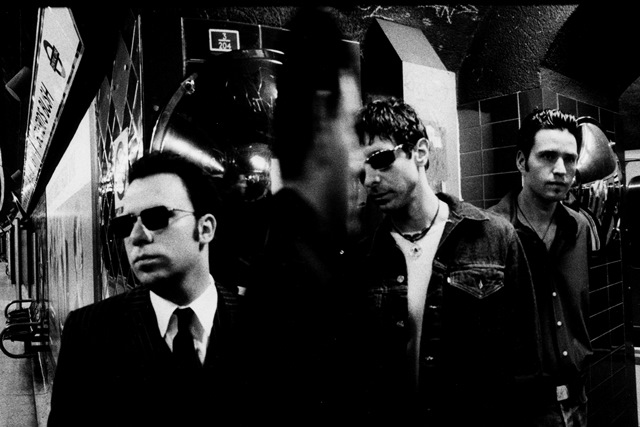
Mercury Rev are on the top of the psychedelic pop scene for more than three decades now. The American band have followed their own artistic instincts, transforming noise into beauty, experimentation into emotion and seemingly chaotic sounds into some of the most dreamlike and unforgettable music of their generation. From their early days as an experimental psychedelic collective in Buffalo, New York, to the orchestral grandeur of “Deserter’s Songs” and the mature, reflective atmosphere of their later work, Mercury Rev have built a remarkable musical legacy.
by Dimitris Zacharopoulos
Mercury Rev were formed in 1989 by a group of students at the University at Buffalo. At the center of the band’s original creative universe were vocalist and guitarist Jonathan Donahue, guitarist and multi-instrumentalist Sean “Grasshopper” Mackowiak, vocalist and keyboardist David Baker, and several musicians who helped shape the group’s unusual early sound.
Beginnings
Their beginnings were far removed from the traditional idea of a rock band. Initially, Mercury Rev were involved in creating soundtracks for student films, experimenting with instruments, noise, unconventional recording techniques and improvised musical passages. Their artistic environment was influenced in part by composer/professor Tony Conrad, whose explorations of drone music helped inspire Grasshopper’s approach to sound.
The band’s early music emerged from a willingness to experiment without worrying about commercial expectations. Guitars could become sources of noise, melodies could disappear into walls of distortion, and familiar musical structures could dissolve into long, unpredictable passages. Rather than attempting to write conventional rock songs, Mercury Rev were interested in creating entire sonic worlds.
Their debut album, “Yerself Is Steam”, released in 1991, captured this restless spirit. It was an album of psychedelic turbulence, noise-rock intensity and strange, almost cinematic atmospheres. Listening to it was less like hearing a collection of traditional songs and more like entering an unfamiliar environment in which beautiful melodies and overwhelming sonic disturbances existed side by side.
The follow-up, “Boces”, released in 1993, continued this experimental journey. The album expanded the band’s already unconventional musical language, combining explosive guitars, psychedelic passages, unusual instrumental textures and a collective approach to songwriting.
Finding Their Own Way Through Chaos
Mercury Rev’s early years were marked by internal tensions and changes in direction. David Baker departed following the touring period around “Boces”, and his departure coincided with a gradual transformation in the band’s sound.
Their third studio album, “See You on the Other Side”, released in 1995, represented an important transitional moment. Although the record retained elements of their psychedelic and experimental origins, it also revealed a growing interest in melody, atmosphere and more structured songwriting.
The album didn’t bring a commercial breakthrough, and the years that followed were difficult. Financial problems, conflicts with their record label and personal struggles threatened their future. The creative relationship between Donahue and Grasshopper also reached a particularly difficult point.
Yet sometimes the most important artistic transformations emerge from moments of uncertainty. Donahue began exploring simpler melodies and different compositional approaches, while his relationship with Grasshopper gradually recovered. Their renewed connection helped establish the foundation for a completely different chapter in Mercury Rev’s history. The result would change everything.
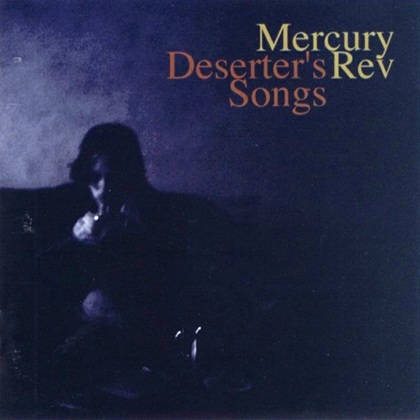
“Deserter’s Songs”: The album that changed everything
Released in 1998, “Deserter’s Songs” remains the defining milestone of Mercury Rev’s career and one of the most extraordinary transformations in alternative rock.
“Deserter’s Songs” presented a more delicate, melodic and emotionally direct band. The guitars were no longer the dominant force in a chaotic sonic battle. Strings, horns, woodwinds, acoustic instruments and carefully arranged textures became central to the music.
The participation of former members of the legendary roots rock and Americana group The Band, including Garth Hudson and Levon Helm, contributed to the album’s connection with American roots music. At the same time, Mercury Rev retained the psychedelic imagination that had always distinguished their work.
The result was elusive: a collection of songs that seemed to exist somewhere between childhood memories, half-remembered dreams and the bittersweet recognition that innocence can never be recovered completely.
Jonathan Donahue’s distinctive, high-register voice became an essential part of this new identity. His vocals often sounded fragile and vulnerable, yet they carried an emotional sincerity that made the songs feel deeply personal.
The album was embraced by critics, with Britain’s NME naming it their “Album of the Year”. Mercury Rev had moved from cult experimentalists to widely celebrated alternative artists without abandoning the imagination that had brought them together.
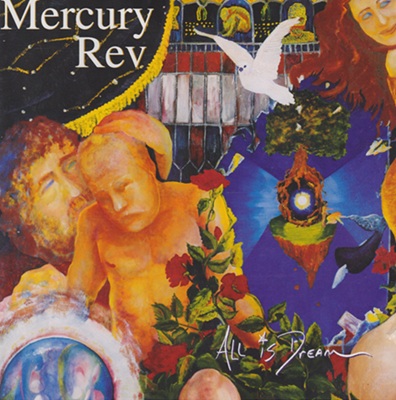
“All Is Dream”: A World of Its Own
“All Is Dream”, released in 2001, confirmed that their transformation was not a one-off event. The album continued the band’s exploration of richly arranged psychedelic pop, combining orchestral instrumentation, unusual sonic details and melodies that seemed to float between reality and imagination. Tony Visconti, renowned for his work with David Bowie, contributed string arrangements and Mellotron parts, adding another dimension to the record’s expansive sound.
Songs such as “The Dark Is Rising”, “Little Rhymes” and “Nite and Fog” demonstrated the band’s ability to create music that was simultaneously accessible and mysterious. “The Dark Is Rising” became one of their most recognizable songs, with its hypnotic progression and gradually intensifying atmosphere. It captured something essential about Mercury Rev: their music could be beautiful without becoming predictable, and emotionally direct without sacrificing its strangeness.
The album reached number 11 on the UK Albums Chart, becoming the band’s highest-charting studio album in Britain.
There was a darker undertone to “All Is Dream”. Its title perfectly reflected the band’s continuing fascination with the unstable boundaries between dreams, memories and waking life.
Continuing the Journey: “The Secret Migration”
“The Secret Migration” (2005) found Mercury Rev exploring another variation of their psychedelic pop aesthetic. The album retained the lush arrangements and melodic sensibility associated with their late-1990s breakthrough, but its atmosphere was often more intimate and reflective. The music seemed less concerned with the dramatic contrasts of their earlier work and more interested in creating a continuous emotional landscape. “In a Funny Way” stood out as one of the record’s most accessible songs, combining warmth and melodic clarity with the band’s characteristic sense of gentle disorientation.
By this point, Mercury Rev had established a distinctive musical identity that could not easily be reduced to a single genre. Psychedelic rock, chamber pop, dream pop, experimental music and American roots influences all formed part of their vocabulary.
Exploring New Territories: “Snowflake Midnight” and “Strange Attractor”
In 2008, Mercury Rev returned with two companion releases: “Snowflake Midnight” and “Strange Attractor”. The former embraced electronic textures and a more synthetic, atmospheric sound, demonstrating that the band were still interested in exploring new possibilities. The accompanying “Strange Attractor”, released as a free digital album, offered instrumental explorations that further emphasized their experimental instincts.
These releases reflected a willingness to take risks, even when the results differed considerably from what longtime listeners might have expected. Mercury Rev had never been a band interested in repeating the same album indefinitely. Their music could be delicate, electronic, psychedelic or orchestral, but it continued to revolve around atmosphere, emotional suggestion and the unexpected connections between sounds.
Returning to the Light
After a seven-year gap between studio albums, Mercury Rev released “The Light in You” in 2015. The album marked another chapter in the continuing evolution of Donahue and Grasshopper’s musical partnership. By this stage, the two had become the band’s central figures, supported by additional musicians and collaborators. “The Light in You” revisited the melodic and psychedelic elements that had defined much of their later work, while incorporating contemporary production and atmospheric electronic details. It was a reminder that Mercury Rev’s identity had never depended on a fixed lineup or a particular instrumental arrangement. Instead, their music emerged from the creative relationship between two musicians who had spent decades exploring the boundaries of sound and melody.

A Tribute to Bobbie Gentry
In 2019, Mercury Rev released “Bobbie Gentry’s The Delta Sweete Revisited”, a reinterpretation of the American singer-songwriter’s 1968 album “The Delta Sweete”. Rather than simply reproducing the original recordings, the band approached the material through their own distinctive musical sensibility. Different guest vocalists performed the songs, including Norah Jones, Lucinda Williams, Beth Orton and Carice van Houten. The project highlighted Mercury Rev’s long-standing connection with American roots music, an influence that had become particularly evident during the recording of “Deserter’s Songs”. It also demonstrated their ability to interpret another artist’s work without erasing its original character. The album was both a tribute to Gentry’s songwriting and a continuation of Mercury Rev’s interest in the emotional possibilities of orchestration, atmosphere and distinctive vocal performances.
“Born Horses”: A new chapter
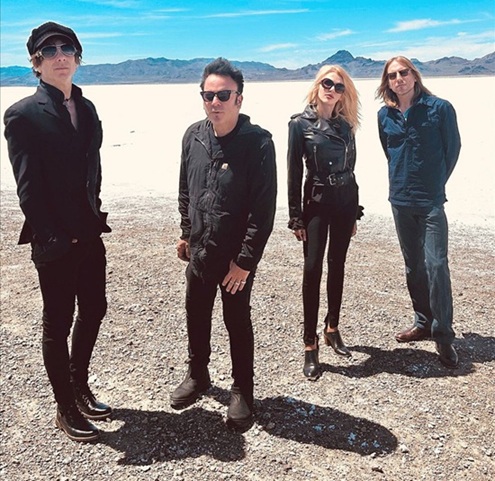
In September 2024, Mercury Rev released “Born Horses”, their first studio album of original material since “The Light in You”. The album brought Donahue and Grasshopper back to the centre of the band’s creative world, continuing their exploration of atmospheric, psychedelic and melodic music. Its release also coincided with changes in the band’s performing lineup, including drummer Joe Magistro and guitarist and flugelhorn player J.B. Meijers. “Born Horses” belongs to a body of work that values atmosphere and emotional expression over trends. It reinforces the idea that Mercury Rev’s greatest achievement is not any single album, but the distinctive musical language they have developed throughout their career.

What makes Mercury Rev so special?
It’s not simply their ability to write beautiful songs, although they have produced some of the most memorable melodies in alternative rock. Nor is it merely their willingness to experiment, even though their early records remain remarkable examples of psychedelic and noise-rock exploration. Their true achievement lies in the way they bring these apparently contradictory qualities together. Mercury Rev understand that beauty does not have to be clean, polished or predictable. Their music can be fragile and overwhelming, comforting and unsettling, accessible and mysterious. A gentle melody may suddenly open into an orchestral passage, while an apparently straightforward song can reveal unexpected emotional depths with repeated listening.
Jonathan Donahue’s voice is central to this identity. Its high register and vulnerable delivery are not designed to dominate the music through sheer power. Instead, his singing often seems to hover above the arrangements, as if he were trying to communicate something that ordinary language cannot quite express. Grasshopper’s guitar work and instrumental imagination provide another essential element. His contributions help create the strange textures and psychedelic dimensions that connect Mercury Rev’s experimental beginnings with their later, more melodic music. Their artistic partnership has endured because neither musician appears interested in reducing the band’s identity to a single formula. Together, they have continued to explore the possibilities of sound, allowing their music to change while preserving its unmistakable sense of wonder.
Mercury Rev are dreamers, explorers and sonic storytellers whose music exists somewhere between psychedelic rock, chamber pop and the uncharted territories of the imagination. Their catalogue contains noise and beauty, melancholy and hope, experimentation and unforgettable melodies.
And their journey continues to fascinate. On October 26, the Greek audience will have the chance to experience a band that dares to experiment, explore, and express its rich spectrum of emotions, as Mercury Rev will play live in Athens, Greece at Gazarte – Ground Stage! We will be there!