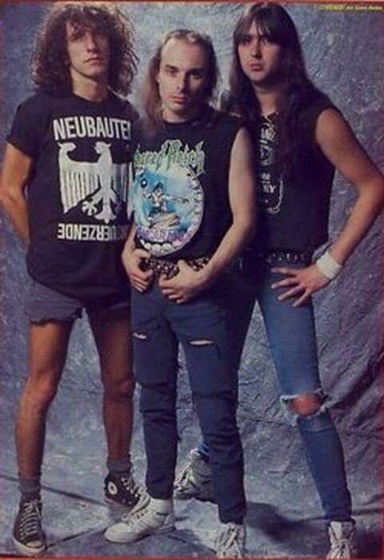
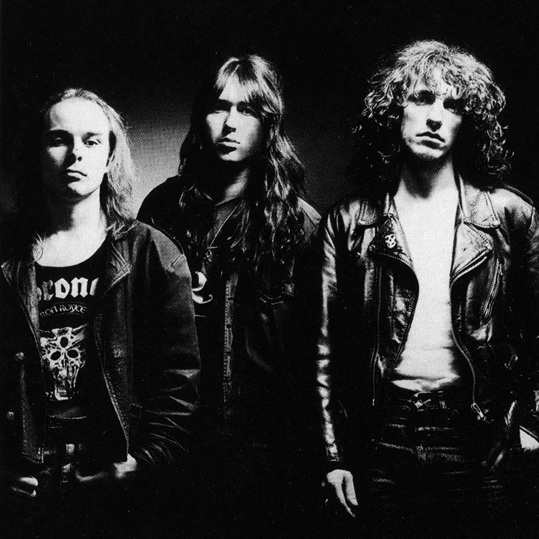
Emerging from Zürich, Switzerland, Coroner became one of the most distinctive forces in European thrash metal, taking the genre’s speed and aggression into increasingly uncharted territory. Only a few days before their live shows in Greece, Myth of Rock is investigating the curious case of Coroner, making a special reference to the “Mental Vortex” album.
by Tasos Bouhoutsos
Founded in 1983 by drummer Marky Edelmann (Marquis Marky), the band initially featured a different line-up before Marky reformed it in 1985 with bassist Ron Broder (Ron Royce) and guitarist Tommy Vetterli (Tommy T. Baron). This trio would go on to define Coroner’s classic era, establishing an unmistakable identity built on technical control, unusual structures and a willingness to look beyond thrash’s traditional boundaries. The band also had early ties to Celtic Frost, whose Tom G. Warrior contributed vocals to Coroner’s “Death Cult” (1986) demo.
Their first albums chart a remarkable progression. “R.I.P.” (1987) delivered a raw, high-speed tech-thrash attack, while “Punishment for Decadence” (1988) introduced greater intricacy and compositional ambition. “No More Color” (1989) refined that approach, bringing tightly interlocked rhythms and elite guitar work to the forefront. Ron Royce’s flexible bass lines and distinctive vocals gave the music a character that technical precision alone could never define. By “Mental Vortex” (1991), Coroner balanced their technical edge and musical experience with progressive elements, driving rhythms and atmospheric depth. “Grin” (1993) shifted towards more minimal grooves, industrial textures and a restrained, mechanical pulse, confirming a band more interested in evolution than repetition.
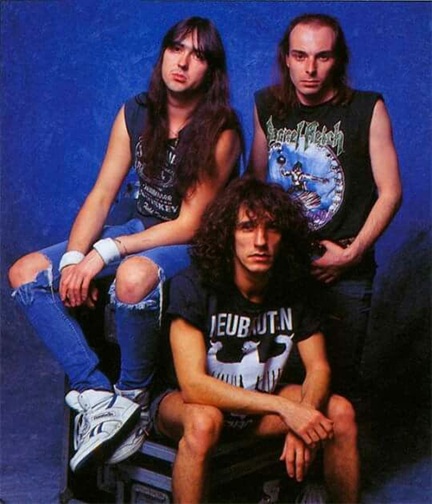
Despite the respect their work earned and their indisputable influence on other artists, Coroner never achieved the wider recognition their rich catalogue deserved. They disbanded in 1996, with the members pursuing different paths, before reuniting in 2010, initially solely for live performances. Marky later stepped away due to his unwillingness to record new material, and drummer Diego Rapacchietti took his place, while Broder and Vetterli remained the band’s central creative partnership.
Released in October 2025, “Dissonance Theory” marked Coroner’s first studio album in more than three decades, reconnecting with their earlier legacy without simply revisiting it. It reflects the creative instinct that carried them from the furious velocity of “R.I.P.” to the colder, groove-driven terrain of “Grin”. Coroner remain a compelling example of technical metal shaped not by virtuosity alone, but by the need to challenge their own limits.
Following their full-scale comeback, the two upcoming shows in Greece – October 30 at Gagarin 205 in Athens and October 31 at Principal Club Theater in Thessaloniki – offer an opportunity to witness Coroner at another high point in their journey, renewed while further strengthening their lasting legacy, underscoring the unique significance of their musical presence.
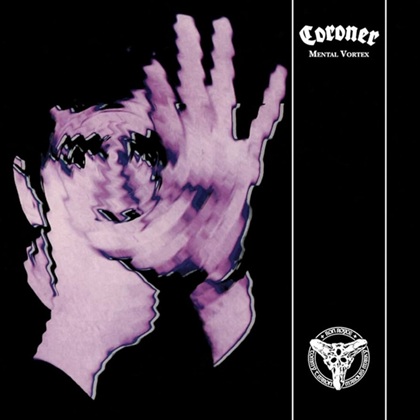
THE SONIC KNOT: “Mental Vortex” (1991, Noise)
Having established their technical thrash approach across their first three albums, Coroner reached a defining point in their evolution with “Mental Vortex”, released on August 12, 1991. Its obscure, unsettling cover draws on the dark imagery of Robert Bloch’s “Psycho”, later immortalized by Alfred Hitchcock’s film. Behind this arresting first impression lies a distinctive sonic identity. Recorded at Sky Trak Studio in Berlin and mixed, produced and engineered by Tom Morris at Morrisound in Florida, the album boasts a clear, powerful production. Already renowned for his work on landmark extreme-metal releases such as Morbid Angel’s “Altars of Madness”, Sepultura’s “Beneath the Remains” and Nocturnus’ “The Key”, Morris gives Coroner’s intricate arrangements a sharper, more vivid sound while preserving their precision and individuality.
Opening samples give way to an exposed guitar line whose gritty yet bright tone immediately draws the listener into the album’s atmosphere, while the drums combine force and precision with intricate patterns and finely judged fills. Ron Royce’s grainy, almost otherworldly voice completes the amalgam, its expressive phrasing lending the songs an unaffected theatricality. Discreet keyboards and atmospheric samples further reinforce the tension and momentum of the album’s restless, circular motion, echoing its conceptual vision.
Progressive rock sensibilities, subtle jazz inflections and avant-garde ideas enrich the arrangements, while infectious grooves and bursts of aggression add dimension without diluting its unapologetic sharpness. Firmly rooted in technical thrash, “Mental Vortex” expands Coroner’s vocabulary through shifting tempos and interweaving riffs that keep the listener absorbed. “Divine Step (Conspectu Mortis)” sets the tone with precision, while “Son of Lilith” and “Metamorphosis” showcase the band’s command of majestic contrast. “Sirens” stands apart, pushing progressive thrash towards a powerful, post-punk-inflected crescendo. The closing cover of The Beatles’ “I Want You (She’s So Heavy)” feels like a both a natural and twisted extension of the album’s hypnotic pull, though its status as the only track to receive a video clip may have limited the album’s promotional potential.
“Mental Vortex” captures Coroner at their creative peak, bridging earlier technical precision and later experimentation. Its enduring impact lies in a distinctive, absorbing sound that rewards those seeking quality beyond the bright lights.