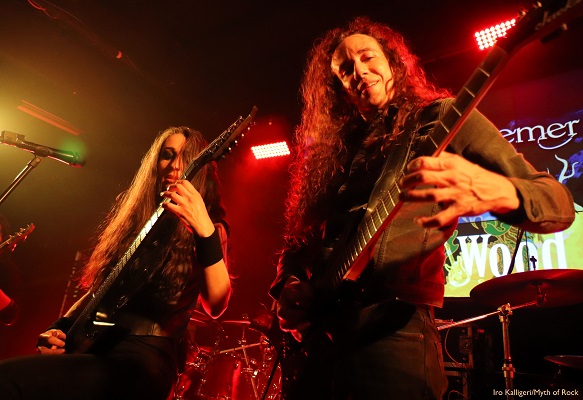

Aephanemer are one of those bands who manage to blend intensity and beauty in a completely natural way. Their music stands at the crossroads of melodic death metal, symphonic elements and folk emotion — powerful, expressive and deeply human. With their new album “Utopie”, they take things even further, exploring the fragile balance between hope and despair in our modern world. I had the chance to speak with Martin Hamiche (guitar) and Marion Bascoul (vocals, guitar) about the band’s evolution, the ideas behind the new record, the songwriting process, and their memories from Greece. Aephanemer are growing — and they have plenty to say.
by Dimitris Zacharopoulos
live photos of Aephanemer by Iro Kalligeri (@irokalligeriphotography)
How did Aephanemer first come together as a band?
Martin: Aephanemer was initially founded in January 2014 as a one-man project, created to release the songs I had written in 2013, starting with the first EP, “Know Thyself”. By March 2014, it quickly became a full band when Marion, our singer, and Mickaël, our drummer, joined the project.
Your new album “Utopie” feels bigger, heavier and more symphonic than ever. What was your main vision when you started working on it?
Martin: when we started working on “Utopie”, there wasn’t a precise vision of making it bigger, heavier, or more symphonic, it’s simply where the songwriting naturally led us. What guided us most was the desire to capture and express the emotions behind the theme of utopia, the mix of hope for a better world and the despair of our current one. I think choosing this theme, combined with our growing experience in making albums, naturally led us to create music that is more intense and expressive than before.
How would you describe the main themes or ideas behind “Utopie”? Is it a concept album in any way?
Marion: For me, “Utopie” is not a concept album in the sense of telling a single story from start to finish. Instead, it explores a set of emotions and ideas that are connected by the theme of utopia. The main focus is on the tension between hope for a better future and the despair we feel in the present. Each song expresses a different aspect of that journey, allowing the listener to connect their own experiences and emotions to the music. It’s less about a specific narrative and more about an emotional and philosophical exploration.
The symphonic parts are incredibly strong on this record. How do you approach writing orchestral arrangements alongside the metal elements?
Martin: Thank you very much! Well, I taught myself to orchestrate music using books, online resources, and a lot of listening to all kinds of music. I learned about all the orchestral instruments, how they work, and how to use them effectively. It’s a very humble process, but I feel the orchestrations on this album are a bit stronger than they were last time. The most difficult part is deciding what the orchestra will play and what belongs to the metal base – guitars, bass, and drums. For me, it’s mostly intuition and done by ear, because I am very non-analytical when I write music.
Are there any classical composers or film soundtrack artists who inspire your orchestral writing?
Martin: Oh, there are plenty! Classical composers like Dvorak, Tchaikovsky, Brahms, and modern ones like Joe Hisaishi or John Williams. But I’m more the kind of person who prefers listening to one track from a hundred different composers than a hundred tracks from just one. I am also inspired by some video games music – the “Halo” OST is like in weekly rotation in my playlists for 20 years.
The guitar work on “Utopie” is phenomenal — how do you usually write your riffs and solos? Do they come first or do you build them around the orchestration?
Martin: Thank you again! Well, I’m obsessed with melodies, so I usually start by writing a kind of “melodic line” that contains all the melodies a song will have from beginning to end. That’s the foreground content. Then I write the bass line, which forms the background, and after that I work on the middle-ground content, made of harmonies and secondary melodies. But I have to admit, the process is always chaotic. It’s never neat or easy. It’s more like writing 10 bars of music, deleting everything except the one I like most, and hoping I can build something from it the next day.
Your singer, Marion, delivers both intensity and grace in her vocals. How does she prepare to move between harsh growls and more melodic, expressive moments?
Marion: Thank you so much! For me, it’s really about connecting to the emotions behind the lyrics. Singing in my own language helps a lot in that, because I can express more intensity and be more in phase with the feelings I want to convey. I also pay close attention to balance and phrasing, making sure the vocals genre fit well to the music parts.
What’s the songwriting process like for Aephanemer? Do you all write together or does someone bring the main ideas first?
Martin: Actually, in Aephanemer, the songwriting is quite simple. I write all the music myself, while Marion writes all the lyrics. Usually, Marion will share her ideas and themes with me first, then I compose the songs from start to finish. Once the music is done, Marion writes the lyrics to fit the mood and structure of each track. After that, I record all the instruments except the drums, and Marion records the vocals.
Which song from “Utopie” do you feel best represents where Aephanemer stand today as a band?
Martin: Oh, that’s easy, it’s the last track, “Utopie (Partie II)”. It’s the final one we wrote, and it’s a track that contains the entire emotional journey toward utopia in itself. It’s also my personal favorite. I honestly wasn’t sure I would be able to write it, and yet I managed to, and I actually really like how it turned out. I love Marion’s lyrics and vocals on it as well.
Your sound has evolved a lot since “Memento Mori” and “Prokopton”. How do you see your musical journey so far?
Martin: To be honest, every time I listen to what I wrote five years ago, I realize how basic and imperfect it was. That’s the curse of being an artist, but also the blessing. It constantly pushes us to create, to try again, and to hope that this time we can capture something that truly feels magical. But I have to say that I am very happy to be more in the category of artists who improve little by little, rather than those who reach their peak very young and try to recreate it all their life. That seems to me a much less fortunate path.
What role do keyboards play in shaping your sound? They seem to add both atmosphere and a sense of storytelling.
Martin: Yes, the orchestrations are really important for us. They let us add harmonies that wouldn’t fit with just guitars and bass, and they also create atmosphere in lots of moments, especially in intros and interludes. They help give the songs a bit of space and a storytelling feeling that we love.
You often mix in small folk touches — how intentional is that, and do you draw from traditional or regional influences?
Martin: Folk music is really at the heart of the music I love. I draw a lot of inspiration from French traditional music, but also from the traditional music of other countries. Those little folk touches naturally find their way into our songs because they’re part of what moves me musically.
The production of “Utopie” sounds massive. Where did you record the album, and what were the biggest challenges during the recording/production process?
Martin: We worked with the same team as on our previous album. The recordings were done with Yannick Tournier at Waiti Studios in our hometown Toulouse, and also partly at home. The album was mixed by Dan Swanö at Unisound AB and mastered at Finnvox Studios by Mika Jussila. Recording and mixing are always the most stressful phases of an album because you want to make the best possible decisions to bring your vision to life, but honestly, there weren’t any real struggles this time. Working with these professionals helped us a lot, and since we’ve collaborated for many years, the process was smoother and more natural than ever.
You’ve been praised for your energetic live shows. How do you translate such dense and symphonic material onto the stage?
Martin: We use backing tracks for the orchestrations, unfortunately. I know it’s not the most exciting answer, but traveling and performing with a full orchestra isn’t realistic for us. We could add a keyboard player for the strings and use backing tracks for the woodwinds and brass, but that often confuses the audience about what is actually being played live, which is not quite satisfying either, because then they wonder if the other instruments are doing playback as well. Our current approach is simple: all orchestral parts are on backing tracks, but everything else – guitars, vocals, bass, drums – is entirely live.
What do you remember from your last shows in Greece less than a year ago?
Marion: I remember in Athens we were about two hours late because our ferry from Italy was cancelled, so we had to take one to Albania and travel through the country without GPS, which was extremely stressful. But the audience was amazing. People were so warm and supportive, and the opening band helped us a lot with carrying and setting up our gear so we could start as soon as possible. Thessaloniki was incredible as well. Greeks are wonderful, welcoming people, and we really love playing there. Our booking agent is currently trying to arrange new shows, so there’s a high chance we’ll be back in early 2026. We’re keeping our fingers crossed!
I was at your concert in Athens, and I remember very well that you were smiling on stage. Are you positive and optimistic people? Is it important for you, both as a band and as individuals, to have good energy?
Marion: Oh, awesome! Yes, it’s really important for us in Aephanemer to convey positive feelings, especially on stage. That’s the impact we want to have on people: hope, energy, joy. That’s truly why we do all of this.
Do you see Aephanemer as part of a new generation of symphonic death metal bands?
Martin: Well, yes, in a way. But it’s really hard to know if there will actually be a new wave of this genre with many new bands. It’s impossible to predict. For us, what matters most is making the music we love, and that’s enough.
How do you personally define “utopia”? Does the title “Utopie” reflect something idealistic about music or life in general?
Marion: For me, utopia isn’t about a perfect world, because perfection doesn’t exist. It’s more about imagining a place or a state where there is a better balance, where people, animals, and the environment coexist in harmony. It’s a space of hope, a way to reflect on what could be improved in life. The title “Utopie” reflects both this idealistic vision and the emotions we tried to capture in the album: the mix of despair about the world today and the hope that things can get better.
What’s next for Aephanemer after “Utopie” — touring, new videos, some orchestral collaborations?
Martin: Oh we will be touring a lot, starting with our first European tour this November. Unfortunately, it doesn’t include Greece, but as we mentioned earlier, we’re booking more shows and should be able to return in early 2026! We’ll continue touring through the first half of 2026, and after that we’ll certainly focus again on writing new music.
What message would you like to send to your fans who have followed you from the beginning and to those just discovering Aephanemer now?
Marion: To all our long-time fans, thank you from the bottom of our hearts. Meeting you at our shows, seeing how our music resonates with you, it’s the most rewarding part of everything we do. And to those discovering Aephanemer now, welcome! We hope our music can take you on an emotional journey, and maybe even help you imagine a little bit of your own utopia. Thank you much for reading!